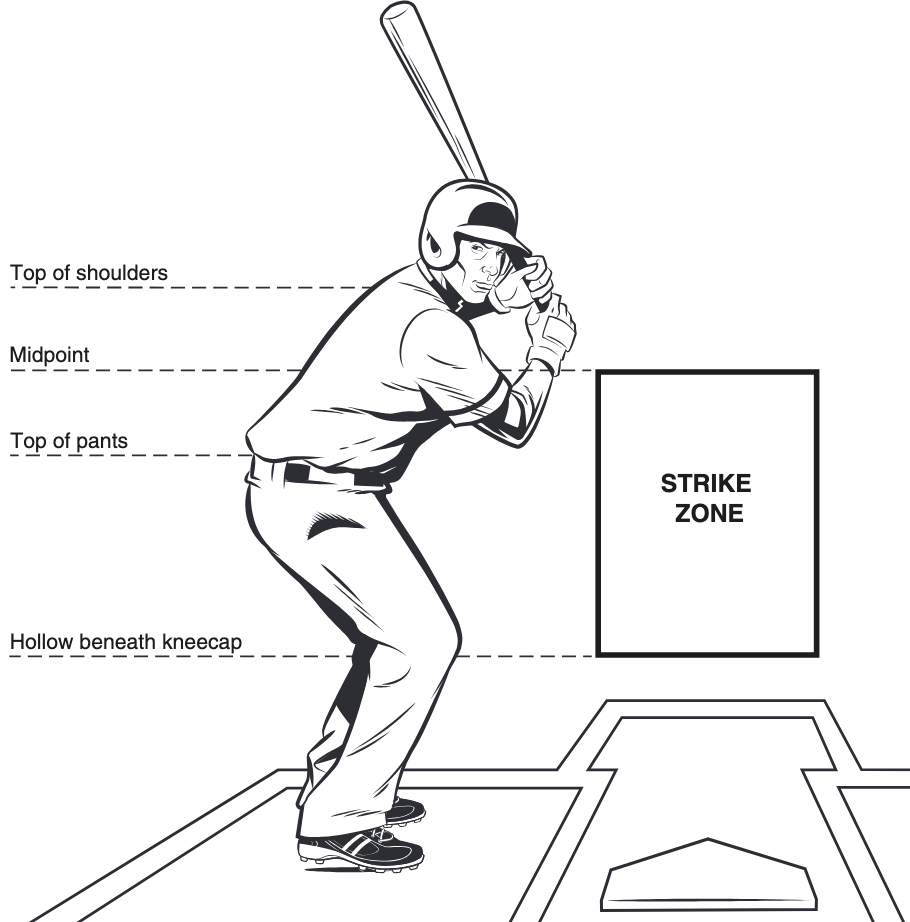
Image courtesy of the official MLB rulebook.
The Strike Zone, Explained
When the ball is pitched, the target for that pitch is usually something called the “strike zone.” The strike zone is the area in which a hitter could be reasonably expected to swing (or strike) at, and be able to hit, a pitch. This, really, is the essence of baseball: the pitcher throws the ball, the batter tries to hit it. The strike zone is where this battle comes to a head. If a batter does not swing at a pitch (also called “taking” a pitch), and that pitch passes through any point of the strike zone, it is by rule a strike. A taken pitch that misses the strike zone, on the other hand, is a ball, at least by rule. If the batter accumulates three strikes over the course of a plate appearance, they are out, and if they accumulate four balls, they are walked, and get to take first base.
But, what is the strike zone? Fair question. For a pitched ball to be called a strike, some part of that ball must pass over home plate. Thus, the horizontal span of the strike zone is always 17 inches across, the width of home plate. Likewise, the strike zone’s depth matches home plate’s ranging from 8.5 inches to 17 inches. The vertical dimensions, meanwhile, vary depending on whomever is up to bat. This dimension is found when the batter is “crouched at the plate and prepared to swing.” The top point is “the midpoint between a batter’s shoulders and the top of the uniform pants,” while the bottom point is “just below the kneecap.” As such, a taller batter will have a taller strike zone, and a shorter batter will have a shorter strike zone.
Now, you might have noticed the words “by rule” in the preceeding paragraphs, especially regarding the outcomes of pitches. This is where it gets complicated— and that complication is only intensified due to a recent rule change made prior to the 2026 season. So! To start with, ever since the strike zone was first created, baseball has needed someone to arbitrate that zone. Enter the home plate umpire, who crouches behind the catcher, and whose main job is to judge pitches are balls, and which are strikes. This brings us to a point universally acknowledged: calling balls and strikes is a tough job, and even the best and most diligent of umpires will occasionally get pitches wrong1. Now, generally, for an umpire, the most important part of calling balls and strikes is not necessarily getting those calls right (though of course, every umpire will want to do so), but making their calls be consistent. If a pitch is called one way, a subsequent pitch that lands in the same location should be called the same way. If an umpire is either inconsistent, or calling pitches strikes/balls when no one else in the ballpark thinks they are strikes/balls, that's when the trouble starts.
What sort of trouble? Well, one hard rule in baseball is that no one is allowed to argue with a ball/strike call that the home plate umpire makes. Players can't argue, coaches can't argue, managers can't argue. Now, that doesn't mean that no one objects to calls they think aren't right, but there's a line to just how strenuous, or strongly-worded, that objection can be. If a player/coach/manager crosses that line, the umpire has the right to eject them. Where that line is depends on a lot of things, including how thin-skinned an individual umpire is. A good umpire generally allows for someone to vent their frustrations without escalating the situation; a bad umpire vents their own frustrations and makes the situation worse for just about everyone involved. Sometimes this can be good theater. Sometimes it's just embarrassing. No matter what, one thing was always true: an umpire's word was final.
Until MLB asked itself: “what if it wasn't final?”